
What is Systems Thinking?
A Primer on Systems Thinking consisting of History, Need, Popular Models, Strategies, and Trends

Traditional analysis often breaks problems into smaller pieces, examining each component separately. This approach works well for simple, isolated issues. But when we face complex problems where multiple factors interact, this method shows its limitations. We miss the connections. We overlook the patterns. We fail to see how changing one element might ripple through the entire system.
Systems thinking offers a different approach. Rather than reducing problems to their parts, it examines how those parts relate to each other and influence the whole. This shift in perspective, from isolated components to interconnected relationships, helps us understand why systems behave as they do and how we might shape them toward better outcomes.
What Systems Thinking Really Means
Systems thinking asks us to see the world differently. Instead of looking at individual events or objects, we look at relationships and patterns. Instead of assuming that A causes B in a straight line, we recognize that B might loop back and influence A. Instead of seeking quick fixes, we explore the underlying structures that create problems in the first place.
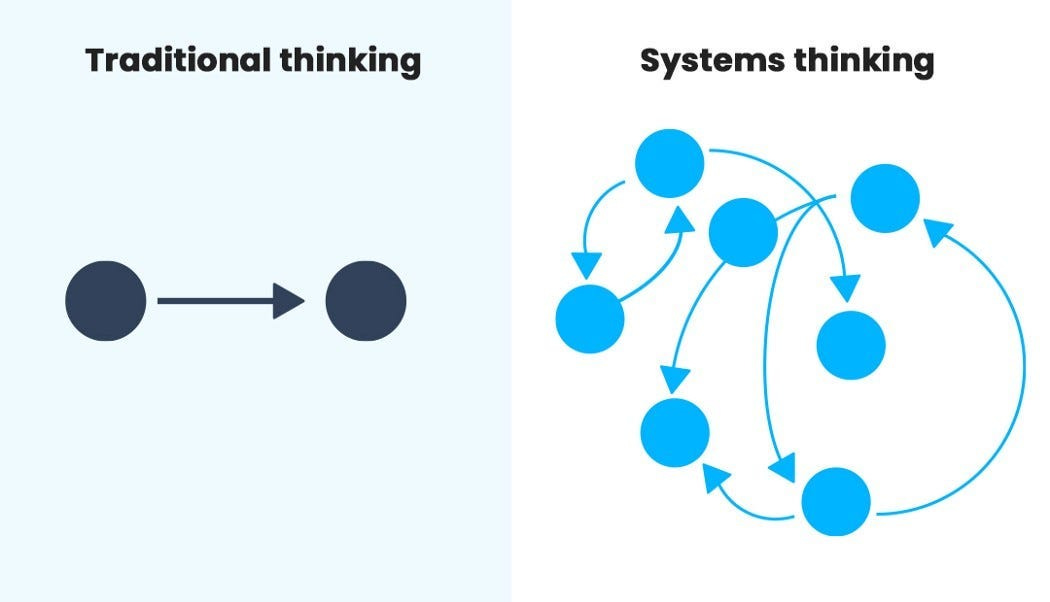
Consider the difference between these two approaches:
Linear thinking focuses on isolated parts, traces cause and effect in one direction, seeks immediate solutions, responds to events as they happen, examines snapshots in time, and assumes simple causal relationships.
Systems thinking examines relationships between parts, recognizes circular causality and feedback, addresses underlying patterns and structures, identifies systemic patterns, observes behaviour over time, and recognises complex, nonlinear relationships.
The main insight is this, the whole is greater than the sum of its parts. A car is more than a pile of metal and rubber. An organisation is more than a collection of individuals. The relationships and interactions between components create something new, something that cannot be understood by studying the parts alone.
Where Systems Thinking Came From
Systems thinking emerged from several intellectual traditions, each contributing different insights.
In the 1940s and 1950s, biologist Ludwig von Bertalanffy developed General Systems Theory. He noticed that certain principles applied across different types of systems, whether biological, social, or technological. His work challenged the prevailing reductionist approach by showing the importance of understanding systems as organised wholes rather than collections of parts.
Around the same time, Norbert Wiener developed cybernetics, the study of how systems regulate themselves through feedback. He explored how both machines and living systems use information about their outputs to adjust their behaviour, maintaining stability or pursuing goals. The thermostat or AC that keeps your room at a constant temperature operates on these cybernetic principles.
In the 1950s, Jay Forrester at MIT created system dynamics, providing mathematical and computational tools to model complex systems. His work led to practical applications in urban planning and industrial management. The 1972 “Limits to Growth” study, which used system dynamics to model global resource constraints and population trends, brought these ideas to a wider audience.
Peter Checkland expanded systems thinking in the 1970s with his Soft Systems Methodology. While earlier approaches focused on technical systems like machines and computers, Checkland recognized that many complex problems involve human activity, multiple perspectives, and contested goals. His methodology acknowledged these softer elements while still providing structured ways to address them.
More recently, complexity theory has enriched systems thinking by exploring how systems self-organise and adapt. The Santa Fe Institute and other researchers have studied how patterns emerge from simple interactions, how systems evolve without central control, and how small changes can cascade through networks in unexpected ways.
Fundamental Principles
Several fundamental principles guide systems thinking. Understanding these helps us analyse any complex system we encounter.
Interconnectedness
Systems consist of elements connected by relationships. Often, these relationships matter more than the elements themselves. A team’s effectiveness depends less on individual skills than on how team members communicate, coordinate, and support each other. A forest ecosystem depends on the interactions between trees, fungi, insects, and decomposers, not just on the presence of these organisms.
When we focus only on elements, we miss the dynamics that actually drive system behaviour. Systems thinking trains us to ask, how do these parts influence each other? What relationships define this system?
Feedback Loops
Feedback occurs when the output of a process feeds back to influence that same process. This creates circular causality rather than linear cause and effect.
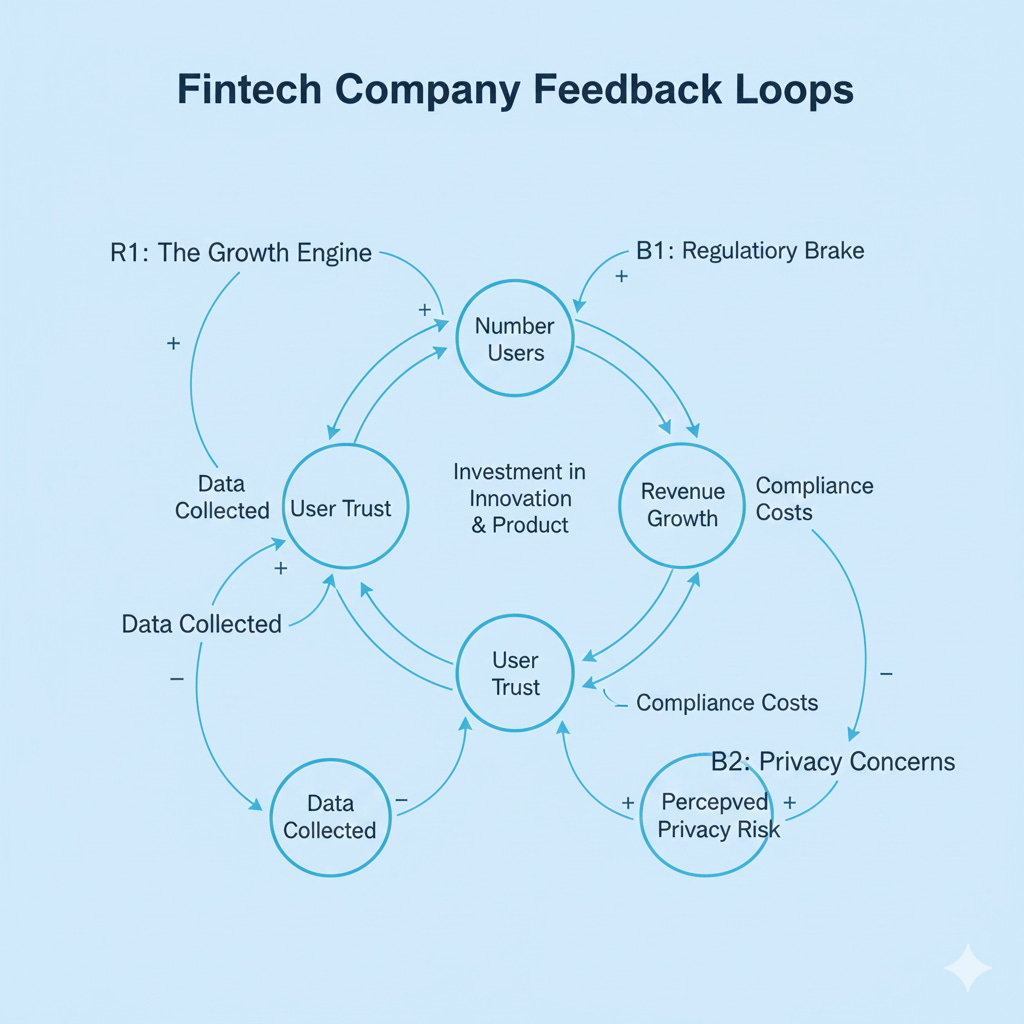
Two types of feedback shape system behaviour:
Reinforcing feedback amplifies change. When a microphone gets too close to a speaker, the sound gets louder and louder in a reinforcing loop. When a company’s success attracts more customers, generating more revenue to invest in improvements that attract even more customers, that’s reinforcing feedback driving growth. These loops can also work in reverse, amplifying decline.
Balancing feedback counteracts change and seeks stability. Your body temperature stays relatively constant because balancing feedback mechanisms increase cooling when you’re hot and increase heat production when you’re cold. A company that hires more staff when workload increases and fewer when workload decreases uses balancing feedback to maintain equilibrium.
Most systems contain multiple feedback loops, some reinforcing and some balancing. Understanding which loops dominate at different times helps explain system behavior.
Emergence
Complex systems exhibit properties that cannot be predicted from studying their parts separately. These emergent properties arise from interactions between components.
Water has properties like fluidity and transparency that you could never deduce from studying hydrogen and oxygen atoms individually. Traffic jams emerge from the interactions of many drivers, even though no single driver intends to create a jam. Consciousness emerges from neural activity in ways we still don’t fully understand.
Emergence reminds us that analysis alone is not enough. We must also observe and understand what arises from the synthesis of parts.
Nonlinearity
In linear relationships, doubling the input doubles the output. Systems rarely work this way. Small changes sometimes produce enormous effects. Large interventions sometimes accomplish little. The relationship between cause and effect curves rather than forming a straight line.
A forest fire might start from a single spark on a dry day, but dozens of sparks on a wet day might accomplish nothing. A rumor might spread exponentially or die out completely depending on context. This nonlinearity makes systems difficult to control and prone to surprises.
Stocks and Flows
Many systems can be understood in terms of what accumulates and what changes over time.
Stocks are quantities you can measure at a point in time, water in a bathtub, money in a bank account, knowledge in your mind, trust in a relationship, carbon dioxide in the atmosphere.
Flows are rates that change stocks, water flowing in and out, deposits and withdrawals, learning and forgetting, trust-building and trust-eroding behaviors, carbon emissions and absorption.
This framework helps us see why systems change slowly or quickly, why they accumulate problems or resources, and where we might intervene to shift trajectories. A bathtub fills when inflow exceeds outflow, no matter how much water it already contains. Similarly, atmospheric carbon dioxide accumulates when emissions exceed absorption, regardless of the current concentration.
Delays
When you turn on a shower, hot water doesn’t arrive instantly. When you start exercising, you don’t see results immediately. When a company invests in training, productivity improvements take time to materialise.
These delays complicate system management because we base decisions on outdated information. We might turn the shower handle too far because the water hasn’t heated up yet, scalding ourselves when it finally does. Companies might cut training budgets because they don’t see immediate returns, undermining long-term capability. Understanding delays helps us anticipate these overshoots and oscillations.
Boundaries
Every analysis requires drawing boundaries around what counts as “the system” and what counts as “environment.” These boundaries are conceptual choices, not physical facts. Where we draw them profoundly influences what we see and what solutions we consider.
Should we analyse a company as an isolated entity or as part of a supply chain? Should we study a city’s transportation system alone or include housing patterns and employment locations? There are no universally correct boundaries, but some choices illuminate problems better than others.
Mental Models
We all carry internal representations of how systems work. These mental models, often implicit and unexamined, guide our actions within systems. When mental models align poorly with reality, we make counterproductive decisions.
A manager who believes that threats motivate performance will act differently than one who believes that psychological safety drives productivity. A doctor who sees illness as resulting from pathogens alone will prescribe differently than one who sees health as emerging from physical, psychological, and social factors.
Systems thinking encourages making mental models explicit, testing them against evidence, and considering alternatives.
Tools for Understanding Systems
Systems thinkers have developed various tools to map, analyse, and communicate about complex systems.
Causal Loop Diagrams
These visual maps show how different elements influence each other through feedback loops. Arrows indicate causal relationships, and labels show whether the influence is positive or negative. Loops are marked as reinforcing (amplifying change) or balancing (seeking stability).
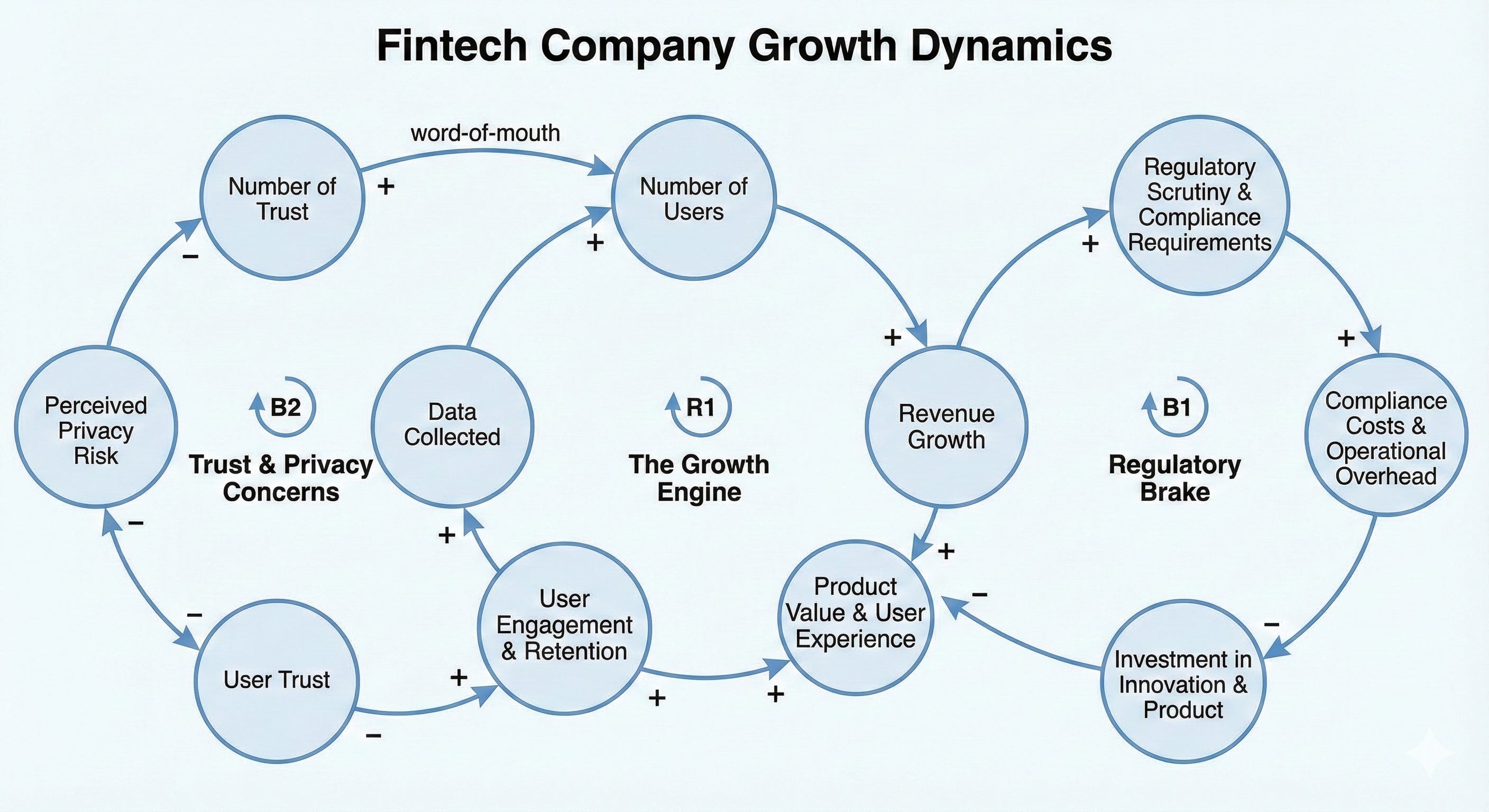
For example, imagine a simple diagram showing workplace stress. High workload increases stress. Stress decreases productivity. Lower productivity means work accumulates faster. More accumulated work means higher workload. This reinforcing loop helps explain why burnout can spiral rapidly once it starts.
Stock and Flow Diagrams
These more detailed models represent accumulations and rates of change, enabling quantitative analysis and simulation. Software like Stella, Vensim, and AnyLogic allows building sophisticated models that can be run forward in time to test different scenarios and policies.
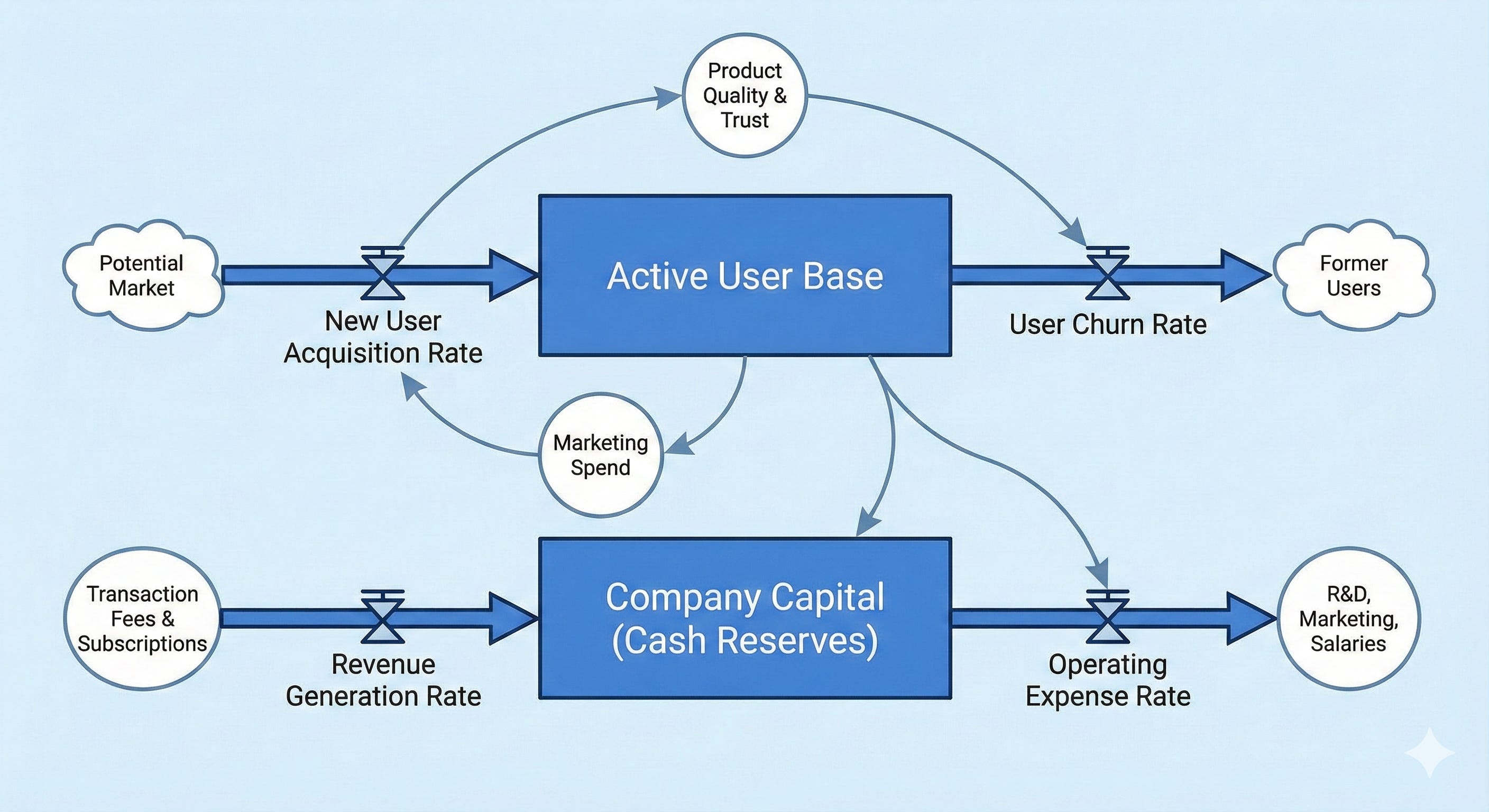
A stock and flow diagram of a city’s housing market might include stocks of available housing and households seeking housing, with flows representing construction, demolition, household formation, and household dissolution. Running such a model helps test whether proposed construction rates can meet projected demand.
The Iceberg Model
This conceptual framework suggests that visible events represent only the surface of deeper systemic issues. Below the waterline lie three levels:
Patterns and trends show how events repeat or change over time. Rather than reacting to a single customer complaint, we notice that complaints have been increasing over several months.
Underlying structures include the relationships, policies, incentives, and resources that generate those patterns. Perhaps complaints are rising because a new compensation system encourages speed over quality.
Mental models are the beliefs, assumptions, and values that sustain those structures. Maybe the organization believes that employees only work hard when directly incentivised, leading to the compensation policy that creates the quality problems that generate complaints.
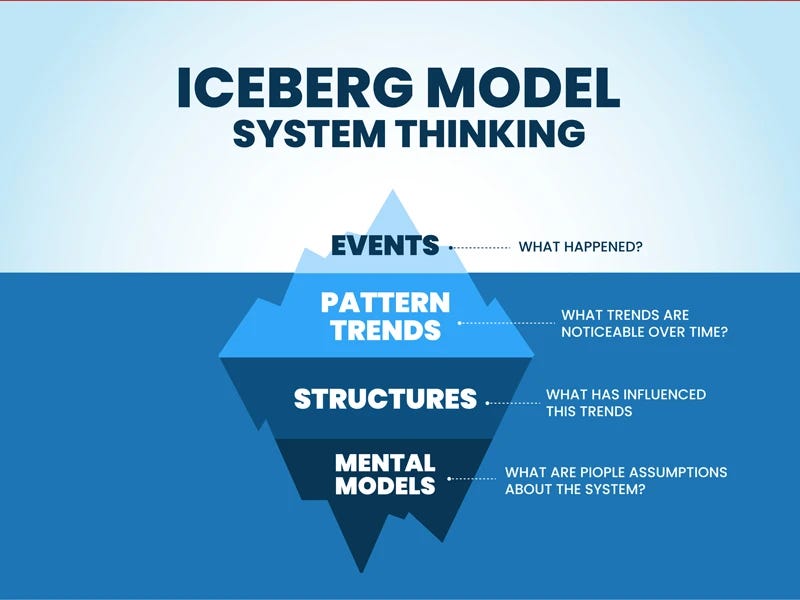
Lasting change requires working at deeper levels. Addressing surface events provides only temporary relief.
Systems Archetypes
Researchers have identified recurring patterns that appear across different contexts. Recognising these common structures helps diagnose problems and identify solutions.
Limits to Growth describes situations where growth meets an unexpected constraint. A company expands rapidly until it exhausts its management capacity or market size.
Shifting the Burden occurs when short-term fixes undermine long-term solutions. Taking pain medication addresses symptoms but might prevent addressing the root cause of chronic pain. Relying on imported food provides immediate relief but might weaken local agricultural capacity.
Tragedy of the Commons happens when individuals rationally pursuing self-interest deplete shared resources. Overfishing, groundwater depletion, and atmospheric pollution all follow this pattern.
Fixes that Fail describes solutions that work initially but create bigger problems later. Suppressing forest fires prevents small burns but allows fuel to accumulate, making eventual fires catastrophic.
Success to the Successful shows how initial advantages become self-reinforcing. Wealthy schools attract better teachers, producing better outcomes, attracting more resources, further increasing quality. This creates divergence over time.
Escalation describes situations where parties respond to perceived threats with increasingly aggressive actions. Arms races and price wars follow this pattern.
Drifting Goals occurs when performance gradually declines as expectations adjust downward. A company tolerates slightly longer customer service wait times, then gradually accepts even longer waits as the new normal.
Each archetype suggests corresponding intervention strategies.
Scenario Planning
Rather than trying to predict a single future, scenario planning develops multiple narratives about how systems might evolve. This helps organisations prepare for various contingencies and identify strategies that work across different futures.
Shell Oil famously used scenario planning in the 1970s to prepare for potential oil crises, giving them a competitive advantage when disruptions occurred. The method has since spread across industries and sectors.
Soft Systems Methodology
Peter Checkland’s approach addresses messy human systems where people disagree about what problems exist or what goals matter. The methodology uses rich pictures to capture different perspectives, develops root definitions of relevant systems, builds conceptual models, and compares these models with current reality to identify potential improvements.
This approach works particularly well for organisational change, policy development, and other contexts where technical solutions alone are insufficient.
Applications Across Fields
Systems thinking has proven valuable across remarkably diverse domains.
Business and Management
Modern organisations operate in complex, interconnected environments where traditional management approaches often fall short. Systems thinking offers better ways to understand and guide organisational behavior.
Peter Senge’s influential book “The Fifth Discipline” positioned systems thinking as essential for creating learning organisations capable of adapting to change. He argued that the ability to see patterns, understand feedback, and recognise mental models separates thriving organisations from failing ones.
Supply chain management now treats chains as complex adaptive systems requiring coordination across multiple entities. Systems approaches help identify vulnerabilities before they cause failures, optimise flows throughout the network, and build resistance against disruptions. The COVID-19 pandemic revealed the fragility of globally distributed supply chains, spurring renewed interest in systems-based approaches to supply chain design.
W. Edwards Deming’s Total Quality Management incorporated systems principles by focusing on optimising entire production systems rather than isolated steps. He emphasized that most quality problems arise from system design rather than worker error, a systems insight that transformed manufacturing.
Research from the McKinsey Global Institute suggests that organisations adopting systems approaches to transformation are 30% more likely to successfully implement complex change initiatives.
Environmental Sustainability
Environmental challenges are inherently systemic, involving complex interactions between natural and human systems across multiple scales.
Climate models represent sophisticated systems thinking tools that capture feedback mechanisms between atmospheric composition, ocean temperatures, ice coverage, vegetation, and other factors. These models show how reinforcing feedbacks can accelerate warming beyond what linear thinking would suggest. Melting ice reduces the Earth’s reflectivity, causing more heat absorption, causing more melting.
Conservation biology has shifted from protecting individual species to preserving ecosystems and ecological functions. A species cannot survive without the system of relationships that supports it. Protecting habitat, maintaining food webs, and preserving ecosystem services requires systems thinking.
Industrial ecology applies systems principles to industrial processes, viewing waste from one process as potential input for another. This mimics natural ecosystems where nothing is truly waste. The Kalundborg industrial symbiosis in Denmark exemplifies this approach, with multiple companies exchanging energy, water, and materials in a closed-loop system.
The planetary boundaries framework, developed by the Stockholm Resilience Centre, identifies nine interconnected Earth system processes with critical thresholds. It recognises that these boundaries interact, so transgressing one boundary might make others more vulnerable. This represents systems thinking applied to global sustainability.
Public Policy and Governance
Policymakers increasingly recognise that isolated interventions often fail when they don’t account for broader systemic factors.
The World Health Organization advocates systems thinking for strengthening health systems. Improving health outcomes requires addressing not just medical care but also education, nutrition, sanitation, social conditions, and environmental factors. These elements interact in complex ways that require systemic understanding.
Urban planning now views cities as complex systems. Transportation patterns affect where people live. Housing patterns affect traffic. Economic development affects both. Environmental quality influences health and property values. Successful cities require integrated approaches that recognise these interconnections rather than optimising each sector independently.
Social service delivery has moved toward integrated models that address interconnected needs. Homelessness, for instance, involves not just housing but also mental health, employment, addiction, family relationships, and legal issues. Addressing any single factor in isolation rarely succeeds.
A 2018 OECD report found that 76% of public sector innovations achieving significant impact employed systems approaches in their design and implementation.
Education
Educational systems benefit from systems perspectives at multiple levels.
Systems-oriented curricula help students understand connections between subjects rather than treating knowledge as fragmented domains. Real problems don’t respect disciplinary boundaries. Climate change involves physics, chemistry, biology, economics, politics, and ethics. Students need to see these connections.
School improvement efforts work best when they address multiple leverage points simultaneously. Teacher development, curriculum design, assessment practices, leadership, community engagement, and resource allocation all interact. Changing one element in isolation rarely produces lasting improvement.
Learning theory itself increasingly reflects systems thinking. Constructivist approaches recognise that learners actively construct knowledge within social and environmental contexts. Learning emerges from the interaction between learner, content, instructor, peers, and environment.
Healthcare
Healthcare delivery is adopting systems approaches at multiple levels.
Patient-centered care views health as emerging from interconnected physical, psychological, and social factors rather than simply the absence of disease. Treating a condition without addressing the life circumstances that contribute to it often produces poor outcomes.
Safety and quality improvement in healthcare increasingly uses systems analysis. Research published in the British Medical Journal indicates that approximately 80% of adverse events result from system failures rather than individual negligence. Blaming individuals without fixing systems ensures that errors continue.
Population health examines how health outcomes emerge from complex interactions between medical care, individual behaviours, social conditions, and environmental factors. Why do some communities have better health outcomes than others? The answer lies in systems, not just in individual choices or medical care quality.
Personal Development
Systems thinking also offers tools for individual growth and self-understanding.
Examining our mental models helps overcome cognitive biases and expand our thinking. We all have assumptions about how the world works, how people behave, and what’s possible. Making these explicit allows us to test and revise them.
Understanding feedback patterns in relationships can break destructive cycles. Defensiveness triggers defensiveness, creating an escalating loop. Appreciation generates appreciation, creating a reinforcing positive dynamic. Recognising these patterns creates opportunities for change.
Personal habits can be viewed as systems with reinforcing loops. Exercise makes you feel better, which motivates more exercise. Isolation leads to low mood, which reduces motivation to socialise, increasing isolation. Understanding these dynamics helps explain why behaviours persist and how to create sustainable change.
Challenges in Practice
Despite its promise, systems thinking faces real obstacles in practice.
Cognitive Limitations
Our brains evolved to detect simple, immediate causes, not complex systemic relationships. Psychological research shows that humans struggle with recognising exponential growth, understanding delayed effects, identifying feedback mechanisms, and thinking beyond immediate consequences.
We see what happens right in front of us. We miss what happens later or elsewhere. We attribute outcomes to recent, visible events rather than to system structures. Overcoming these cognitive biases requires conscious effort and practice.
Methodological Complexity
Applying systems methods effectively requires specialised knowledge and skills. Building accurate models demands significant expertise. Gathering relevant data across system boundaries presents practical difficulties. Validating system models poses unique challenges since we cannot run controlled experiments on many real-world systems. Communicating complex insights to stakeholders requires translation into accessible language.
These barriers limit who can effectively use systems approaches, though efforts to democratise these tools continue.
Institutional Barriers
Existing organisational structures often impede systems approaches. Departments operate in silos, separating interconnected issues. Budget cycles favor short-term results over long-term system health. Specialisation in education and professional training limits cross-boundary understanding. Decision-making processes demand clear, simple causality even when reality is complex.
A 2019 survey of Fortune 500 executives found that while 87% recognised the importance of systems approaches, only 12% reported having organisational structures that effectively supported implementation. Awareness exceeds capability by a wide margin.
Developing Systems Thinking Capability
Building systems thinking capacity involves cultivating certain mindsets and skills.
Important Mindsets
Seeing wholes rather than fragments. Training ourselves to zoom out and see the bigger picture, to notice what connects elements rather than just the elements themselves.
Recognising dynamics over time rather than static snapshots. Asking how things change, what trends are emerging, whether patterns are stable or shifting.
Understanding operations rather than accepting surface explanations. Digging into how things actually work, not just how they’re supposed to work or how we wish they worked.
Thinking in loops rather than lines. Recognising that effects feed back to causes, that circular causality is common, that we’re often part of the systems we’re trying to change.
Essential Skills
Visualising relationships by creating maps and diagrams that show connections and influences.
Identifying feedback by recognising when outputs loop back to affect inputs, distinguishing reinforcing from balancing loops.
Understanding stocks and flows by tracking what accumulates and what changes, seeing how quantities build up or drain over time.
Recognising delays by accounting for time lags between actions and consequences, anticipating overshoots and oscillations.
Finding leverage points by identifying where small changes might produce large effects, where interventions might shift system behavior.
Learning Pathways
Developing these capabilities typically progresses through stages. First comes conceptual understanding of foundational principles. Then comes tools mastery, gaining proficiency with specific methods. Next comes application practice, working with progressively more complex situations. Finally comes reflection and refinement, continuously improving mental models based on experience.
Educational programs from institutions like the Waters Center for Systems Thinking, the System Dynamics Society, and the Cabrera Research Lab offer structured learning pathways. Books, online courses, and communities of practice provide additional resources.
Future Trends
As global challenges grow more complex and interconnected, systems thinking continues to evolve and expand.
Integration with Data Science
The explosion of available data combined with advanced analytics creates new opportunities for understanding complex systems. Machine learning algorithms can identify patterns not obvious to human observers. Big data enables more comprehensive mapping of system relationships. Computational modeling allows testing interventions in virtual environments before trying them in reality.
These tools don’t replace human judgment but augment our capacity to understand complexity.
Democratising Systems Tools
User-friendly technologies are making systems methods more accessible to non-experts. Visual modeling tools with intuitive interfaces lower technical barriers. Online collaboration platforms enable participatory systems mapping where stakeholders can collectively build understanding. Gamified approaches make systems concepts more engaging for learners.
As tools become more accessible, more people can apply systems thinking to their own contexts and challenges.
Cross-Disciplinary Integration
Systems approaches transcend traditional boundaries. Socio-ecological systems research integrates social and ecological dimensions previously studied separately. Socio-technical systems examine interactions between human and technological elements. One Health connects human, animal, and environmental health.
These integrative approaches recognise that real problems don’t respect academic disciplines. Addressing them requires bringing together insights from multiple fields.
Addressing Global Challenges
Systems thinking proves essential for tackling complex global issues. Pandemic response requires understanding interconnections between public health, economic systems, social behaviour, and political dynamics. Climate adaptation demands integrated approaches across sectors and scales. Food security involves complex relationships between agriculture, economics, climate, culture, and politics.
None of these challenges can be solved through simple, isolated interventions. They require the kind of holistic, dynamic, interconnected thinking that systems approaches provide.
Ending Note
Systems thinking represents more than a set of tools or techniques. It constitutes a different way of seeing and engaging with complexity. By observing interconnections, understanding feedback dynamics, and identifying leverage points for change, systems thinking offers pathways to more effective action.
Management theorist Russell Ackoff observed, “The systems approach is not a bad idea that failed. It is a good idea that has not yet been tried.” While this may have been true when he wrote it, systems approaches are now finding practical expression across many fields. The question is no longer whether systems thinking has value but how we can apply it more widely and effectively.
Global challenges continue to grow more complex and interconnected. Climate change, pandemics, economic inequality, technological disruption, and other issues demand systemic understanding. Linear thinking and isolated interventions will not suffice. We need approaches that match the complexity of the problems we face.
Systems thinking offers not just analytical power but also a form of hope. It reminds us that seemingly intractable problems often arise from structures we ourselves have created and therefore can redesign. By understanding systems, we enhance our collective capacity to shape them toward more sustainable, equitable, and resilient outcomes.
The forest and the trees both matter. Systems thinking helps us see both at once.
Further Resources
Books
Meadows, D. (2008). Thinking in Systems: A Primer. Chelsea Green Publishing.
Senge, P. (2006). The Fifth Discipline: The Art & Practice of The Learning Organization. Doubleday.
Stroh, D.P. (2015). Systems Thinking for Social Change. Chelsea Green Publishing.
Sterman, J. (2000). Business Dynamics: Systems Thinking and Modeling for a Complex World. McGraw-Hill Education.
Checkland, P. (1999). Systems Thinking, Systems Practice. John Wiley & Sons.
Organizations and Networks
The Systems Thinking World Network
The System Dynamics Society
The Waters Center for Systems Thinking
The Santa Fe Institute
The Cabrera Research Lab
Online Courses and Resources
MIT System Dynamics Open Courseware
The Systems Thinker (online publication)
Creative Learning Exchange (K-12 systems education)
Systems Innovation Network
The Donella Meadows Project
Tools and Software
Kumu (systems mapping platform)
Vensim (system dynamics software)
Stella Architect (system modeling tool)
Loopy (simple online feedback loop creator)
Insight Maker (free online simulation tool)